CHEMISTRY · MACHINE LEARNING · AUTOMATION

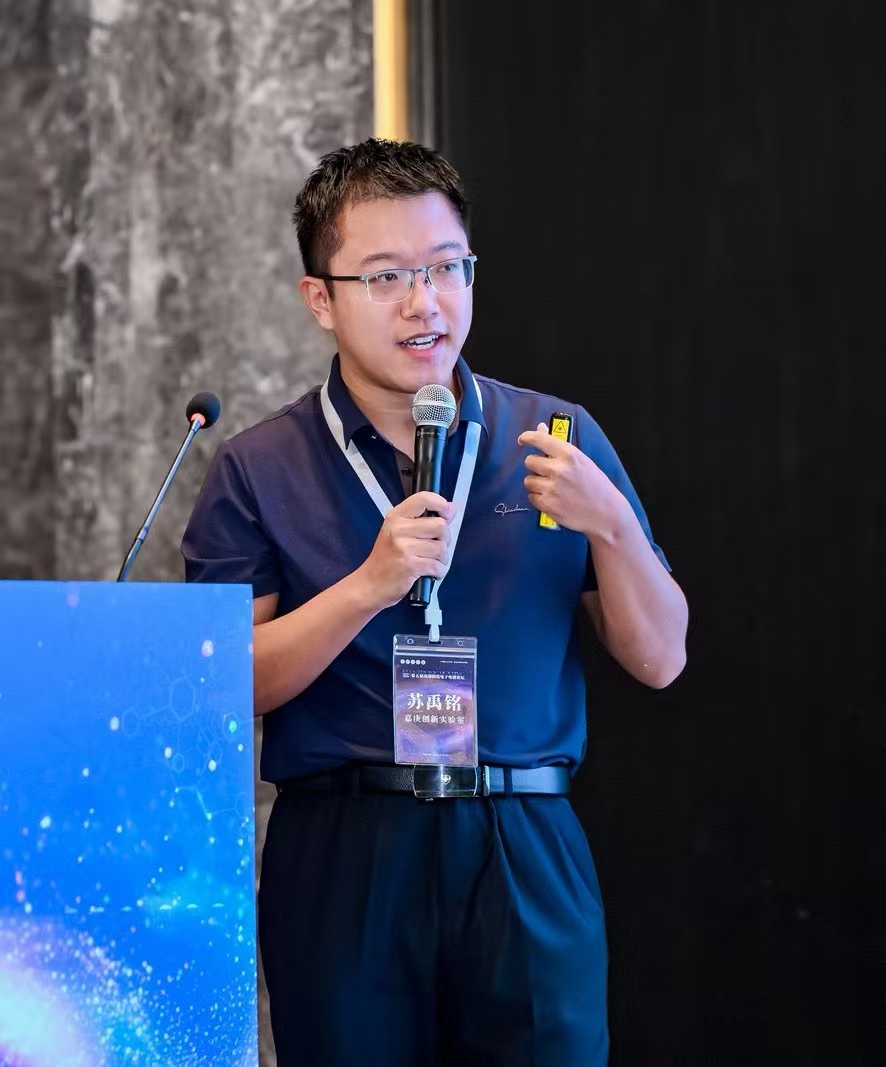
Yuming Su苏禹铭

Assistant Researcher

Xiamen University · AI4EC Lab, IKKEM
Xiamen, China

Understanding chemistry with interpretable models.
Exploring materials through automated experiments.

Yuming Su / 苏禹铭
782Citations
14h-index
15i10-index
Google Scholar snapshot ↗
As of 2026-10-19 · not a live feed

ABOUT / BACKGROUND

Connecting chemistry, data & experiments

My research asks how complex chemical information can become interpretable models and actionable experimental decisions.

I combine theoretical calculations, molecular representations and machine learning to investigate structure–property relationships in chemistry and materials. I develop research software including Surfacia, and extend these methods toward automated electrochemistry, electroplating and AI-agent-assisted experiments. My interests include two-photon absorption, molecular surface descriptors, catalysis and materials optimization.

I aim to connect method development and reusable software with real chemical questions, using data and models to support both prediction and the design of subsequent experiments.

2024–
Assistant Researcher
AI4EC Lab, IKKEM
2018–2024
Ph.D. in Chemistry
College of Chemistry and Chemical Engineering, Xiamen University
2014–2018
B.S. in Chemistry
College of Chemistry and Chemical Engineering, Shanxi University

RESEARCH / QUESTIONS & METHODS

Research interests

Six SHAP analyses relating two-photon absorption to conjugation, fragment descriptors, wavelength and solvent. View full figure ↗
Interpreting structure–property relationships: SHAP analysis from our two-photon absorption study.Y. Su et al. · Advanced Science (2023) · Fig. 4 · © The Authors · CC BY 4.0
01

Interpretable chemical machine learning

Connecting molecular structure, property prediction and chemical interpretation through molecular surfaces, local functional groups and electronic descriptors.

SurfaciaLoFFiStructure–property relationships
Overview connecting literature extraction, datasets, hypotheses, experiment design and computational analysis in catalyst discovery. View full figure ↗
Connecting information, experiments and computation: the overview from our 2024 review.Y. Su et al. · Chemical Science (2024) · Fig. 1 · © RSC · CC BY-NC 3.0
02

Automated electrochemistry & electroplating

Developing workflows for automated dosing, electrochemical measurements, data analysis and experimental decisions, linking molecular design with interface responses and deposit performance.

ElectroplatingElectrochemistryAI agents
Two-photon absorption workflow from experimental molecules through fragment and conjugation features to model validation and chemical hypotheses. View full figure ↗
Two-photon absorption: molecular features, model validation and chemically testable hypotheses.Y. Su et al. · Advanced Science (2023) · Fig. 2 · © The Authors · CC BY 4.0
03

Photofunctional materials & computational chemistry

Combining quantum chemistry and machine learning for two-photon absorption, framework materials and catalysis, supported by reusable research software and data tools.

Two-photon absorptionQuantum chemistryCatalysis

SOFTWARE / RESEARCH TOOLS

From methods to usable tools

GitHub ↗

Online trials are free to use; email verification and administrator approval are required.

Total visits across six software pages …

Since 2026-10-21. Detail-page visits only; English and Chinese combined, once per software per tab within 30 minutes. Not unique visitors or computations.

01
Molecular representations · Interpretable ML
Recorded visits …

A workflow connecting molecular structures and surface properties with chemically interpretable descriptors, feature selection, predictive modeling and model interpretation.

Explore ↗ Surfacia
02
Spectral digitization · Evidence-guided review
Recorded visits …

A local workflow connecting OCR, coordinate calibration and curve extraction with optional vision-language-model review for scientific charts and chemical spectra.

Explore ↗ GBLine
03
Literature research · Knowledge workflows
Recorded visits …

A local literature research tool connecting page reading, LLM analysis, citation expansion and local research records.

Explore ↗ handle_candle
04
Chemical education · No-code ML
Recorded visits …

A graphical decision-tree tool and five teaching datasets introducing feature engineering through organic acid pKa prediction.

Explore ↗ pKa-ML Education

PUBLICATIONS / RESEARCH OUTPUTS

Publications & scholarly work

Full list on Scholar ↗

First-author (including co-first) and corresponding-author papers are shown first; other papers follow by citation count. Citation snapshot: 2026-10-19. Counts not verified for newly added papers are marked as not recorded. See Google Scholar for the full list.

Showing 10 papers

  1. 2023
    Interpretable Machine Learning of Two-Photon Absorption

    Yuming Su, Yiheng Dai, Yifan Zeng, Caiyun Wei, Yangtao Chen, Fuchun Ge, Peikun Zheng, Da Zhou, Pavlo O. Dral, Cheng Wang

    Advanced Science · 10 (8), 2204902

    36citations
  2. 2023
    Uncovering the influence of the modifier redox potential on CO2 reduction through combined data-driven machine learning and hypothesis-driven experimentation

    X. He, Y. Su, J. Zhu, N. Fang, Y. T. Chen, H. Liu, D. Zhou, C. Wang

    Journal of Materials Chemistry A · 11 (34), 18106–18114

    5citations
  3. 2022
    Two-photon 3D printing in metal–organic framework single crystals

    Y. Zhang, Y. Su, Y. Zhao, Z. Wang, C. Wang

    Small · 18 (18), 2200514

    46citations
  4. 2023
    Hexa-branched nanographenes with large two-photon absorption

    Xin-Jing Zhao, Yang-Yang Ju, Yu-Ming Su, Chun Tang, Qi Zeng, LiuBin Feng, Cheng Wang, Klaus Müllen, Yuan-Zhi Tan

    Journal of the American Chemical Society · 145 (35), 19333–19337

    19citations
  5. 2024
    Automation and machine learning augmented by large language models in a catalysis study

    Y. Su, X. Wang, Y. Ye, Y. Xie, Y. Xu, Y. Jiang, C. Wang

    Chemical Science · 15 (31), 12200–12233

    131citations
  6. 2025
    Revealing Transition State Stabilization in Organocatalytic Ring-Opening Polymerization Using Data Science

    M. Zhang, Y. Su, T. Du, S. Ding, J. Dai, C. Wang, Y. Liu

    Angewandte Chemie International Edition · 64 (23), e202502090

    17citations
  7. 2026
    Improving Quantum-Chemical Prediction of 19F NMR Chemical Shifts via Machine Learning

    Dongdong Chen, Yuanxiang Ye, Yijie Zhu, Yibin Jiang, Yuming Su, Cheng Wang

    Journal of Chemical Information and Modeling · 66 (17), 10538–10547

    —Not recorded
  8. 2021
    Machine-Learning-Guided Discovery and Optimization of Additives in Preparing Cu Catalysts for CO2 Reduction

    Y. Guo, X. He, Y. Su, Y. Dai, M. Xie, S. Yang, J. Chen, K. Wang, D. Zhou, et al.

    Journal of the American Chemical Society · 143 (15), 5755–5762

    171citations
  9. 2025
    Observation of metal-organic interphase in Cu-based electrochemical CO2-to-ethanol conversion

    Yan Shen, Nan Fang, Xinru Liu, Yu Ling, Yuming Su, Tian Tan, Feng Chen, He Lin, Boxuan Zhao, Jin Wang, Duanhui Si, Shunji Xie, Ye Wang, Da Zhou, Teng Zhang, Rong Cao, Cheng Wang

    Nature Communications · 16 (1), 2073

    94citations
  10. 2024
    MLatom 3: a platform for machine learning-enhanced computational chemistry simulations and workflows

    Pavlo O. Dral, Fuchun Ge, Yi-Fan Hou, Peikun Zheng, Yuxinxin Chen, Mario Barbatti, Olexandr Isayev, Cheng Wang, Bao-Xin Xue, Max Pinheiro Jr, Yuming Su, Yiheng Dai, Yangtao Chen, Lina Zhang, Shuang Zhang, Arif Ullah, Quanhao Zhang, Yanchi Ou

    Journal of Chemical Theory and Computation · 20 (3), 1193–1213

    92citations

Contact

Let’s explore a question together.

Open to conversations on interpretable machine learning, chemistry, materials and automated experiments.

yumingsu@xmu.edu.cn